Hidden Heat: Battery disposal gaps keep fueling fires as states consider who should foot the bill
As lithium-ion battery fires increasingly plague landfills and recycling centers, some want the industry to take greater responsibility
(InvestigateTV) — In a matter of seconds, the battery powering any number of devices within arm’s reach of the average consumer has the potential to transform from an efficient energy source into a fire ball the temperature of a volcanic eruption.
Lithium-ion batteries, with their energy-dense chemistry and falling cost of production, have grown to dominate the rechargeable battery market.
As that popularity has increased, experts say the ability of those batteries to ignite or even explode under certain conditions has meant as the number of fires linked to them has also gone up.
Because of the risk, numerous consumer-education campaigns have pushed for proper handling and disposal of lithium-ion batteries.
However, InvestigateTV found there are often barriers to doing so, with many communities having limited drop-off locations with expensive disposal alternatives — especially when it comes to damaged, defective or recalled lithium-ion batteries.
And whether due to lack of education or lack of access, landfills and recycling centers in particular are feeling the heat when people throw lithium-ion batteries in the trash accidentally or as a last resort.
“It’s got to be convenient for the consumer,” said Scott Cassel, CEO and founder of the Product Stewardship Institute. “They need to be educated through the education, and then the systems have to be in place.”
Over the last few years, several states have passed laws that would put the burden of managing what happens to lithium-ion batteries back on manufacturers, and the federal government is putting together a framework to help guide future legislation.
Without it, many experts say taxpayers and battery users will continue to get burned.
Highly Charged
Since the recall of Samsung Galaxy Note 7 smartphones in 2016, anyone who has flown on a commercial airline has likely heard at least some kind of warning about lithium-ion batteries.
After batteries in the affected phones began overheating and igniting, the Federal Aviation Administration immediately banned the specific devices on commercial flights, as damaged, defective or recalled lithium-ion batteries are prohibited from air transportation, and went on to ban any spare batteries from checked luggage.
But over the last five years, FAA data shows there has been a notable increase in the number of battery ignitions on commercial flights, with 97 incidents in 2025 alone.
The primary culprit: portable battery charging banks, often called “power banks,” caused more than a third of the incidents in 2025 and more than half of the events so far this year.
This has caused a recent crackdown among airlines. As of May 1, most now limit the number of charging banks passengers can bring on board, require the devices always be visible and accessible, and some are even restricting the charging or use of them during flight.
As a frequent flyer, Grover Joseph Rees said he knew in theory from the announcements made by countless gate agents and flight crews that lithium-ion batteries could be dangerous.
“I was aware of it because they won’t let you put them in checked bags and so forth,” he said.
Rees, a retired United States diplomat and attorney who now works from his Lafayette, Louisiana home, said while he had heard the pre-flight warnings and seen the occasional news story about battery fires, he used portable power banks for years as a means of keeping his smartphone charged.
The phone’s battery life was frustratingly short, so he said he would often keep a power bank in his pocket throughout the day, unconcerned about any fire risk.
“I just didn’t think it would ever happen,” he said. “It was like being struck by lightning or being eaten by an alligator. There are those are things that can happen to you, but you don’t really plan your life around them.”
The actual likelihood of a fire is difficult to calculate — there is no single data source used to track lithium-ion battery fires — but the National Institute of Standards and Technology, part of the U.S. Department of Commerce, estimates there have been around 198,000 structure fires caused by lithium-ion batteries since 2011.
The NIST also estimates that the number of fires is growing by roughly 10% each year.
In June of 2025, Rees experienced one of them at his home.

“Suddenly there was a loud noise and there were flames,” Rees said. “And of course I didn’t have time to think about where the flames were, I started running away from them.”
Rees said he remembers running from the room into his kitchen.
“And then at some point, and I’m sure it was only a matter of a second or two, I realized that the flames were on me,” he said.
To anyone else, it might have seemed as if the front pocket of the shorts Rees was wearing had burst into flames out of nowhere while he was mopping the floor.
Rees, however, said he knew right away.
“Perhaps because of this recall a week ago that I’d read about, I instantly knew what it was,” he said.
That recall, issued just six days before, was for more than 1.1 million Anker Innovations power banks, and came about after 19 reported cases of fires and explosions involving the batteries in the charging packs.
Rees said he was able to quickly get the shorts off and on the ground before trying to smother the fire but was unable to extinguish it.
“There was a subsequent explosion of the other batteries in the charger that hadn’t exploded initially,” he said, “and the fire went from a little fire to a really big fire, very tall, going up almost to the ceiling.”
As the fire spread to a cabinet, Rees said he was able to call 911 on his landline.
“I had seen from my leg that I was badly burned, and I was calling for an ambulance,” he said, “and so while I had 911 on the phone, I said, ‘Oh, and you better send a fire truck, because the house is on fire too.’”
Rees said he sustained second and third-degree burns to his thigh and was in the hospital for nearly two weeks.
Heated Pyrometry
Lithium-ion batteries are prone to “thermal runaway” — an uncontrollable increase in temperature caused, in this case, by the same chemistry that makes the batteries such an efficient power source.
An increase in heat causes the battery’s inherent chemical reaction to speed up, which not only produces more heat, but can cause the battery to emit flammable gasses. Under the right conditions, this can cause a fire that both fuels itself and can reach more than 1800°F — the same temperature as the explosive flow of many volcanic eruptions.
As a result, lithium-ion battery fires easily cause significant structural damage.
In addition to Rees’s case, InvestigateTV identified dozens of homes and businesses destroyed and people injured in the last year just from reviewing affiliate news coverage.
In October, the National Fire Protection Association dedicated its annual fire prevention week to lithium-ion batteries.
But while these fires are often devastating for the average consumer, they can also be catastrophic for waste treatment and recycling facilities.
With high volumes of highly-combustible materials and facilities that are sometimes difficult for traditional firefighting infrastructure to access, a federal research survey found 1-in-4 lithium-ion battery fires at waste facilities result in service disruption and hundreds of thousands of dollars in damage.
“Our waste and recycling operators … they’re the victims of this equation,” said fire protection expert Ryan Fogleman.
Fogleman, who has served on multiple National Fire Protection Association committees, is also an executive at Fire Rover, which provides automated fire detection and suppression systems for places like waste and recycling facilities.
According to 2025 usage data from the company, the system identified more than 3,600 developing fires and hotspots last year, with events escalating to require fire department intervention more than 450 times.
“We have some great operators in this country, and they’re still seeing these types of hazards,” he said, “and fires are going to wreak havoc with your operations and your investment.”
Rumpke Waste & Recycling, a regional company but also the 10th-largest waste services provider in the U.S., is one of Fire Rover’s clients.
InvestigateTV was given a demonstration of the system at Rumpke’s Columbus, Ohio recycling facility, which despite opening in just 2024, has already had to use it multiple times.
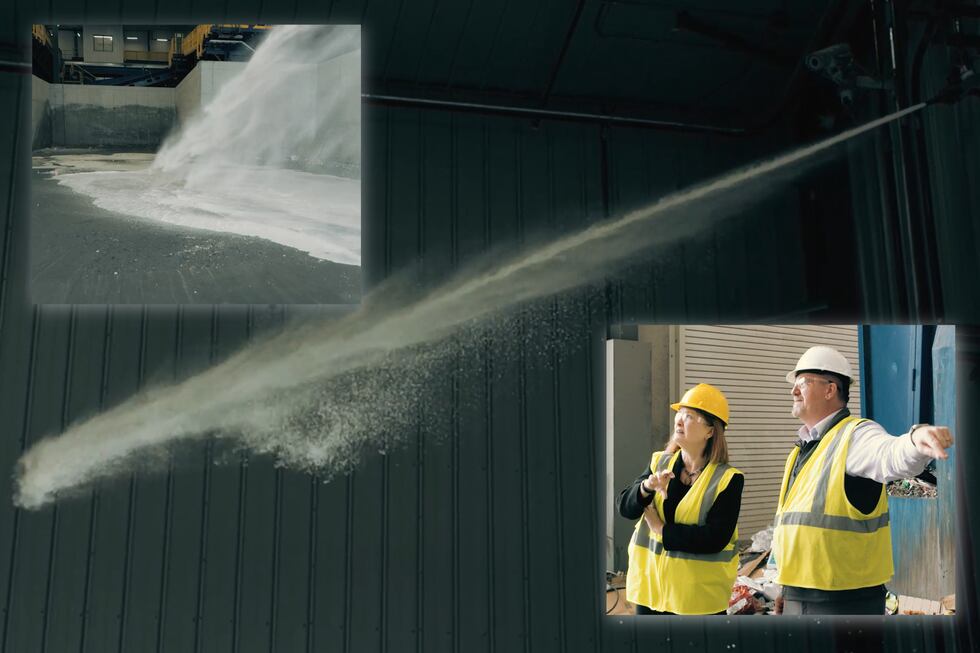
“We’ve used that system three or four times to be able to put out the fires inside of this facility,” Rumpke Senior Vice President of Recycling & Sustainability Jeff Snyder said.
Not all waste and recycling fires are caused by lithium-ion batteries, but EPA research found waste processors consistently report them as the largest cause of fires.
This, Snyder said, is because starting at the curb, the processing of waste materials often includes crushing and compacting — an action that is likely to damage a battery in such a way that would cause thermal runaway.
Many facilities have implemented X-Ray technology and other methods of screening for batteries and battery-containing devices. Snyder said his facilities each regularly find 200-300 lithium-ion batteries mixed in with waste materials each day — any one of which has the potential to spark a fire capable of burning the facility to the ground.
“I don’t think people understand the importance and how to handle batteries, and what batteries can potentially do to a facility, or to a landfill or to a truck,” he said.
Access
From the National Fire Protection Association’s prevention campaign to reminders from fire departments responding to burning homes, consumers are consistently given the same message: use and dispose of lithium-ion batteries properly.
Doing so, however, may be more challenging than it sounds.
“There are many different types and different sizes of batteries, and the biggest issue, in terms of solving this, is to make it convenient for the consumer,” said Scott Cassel of the Product Stewardship Institute.
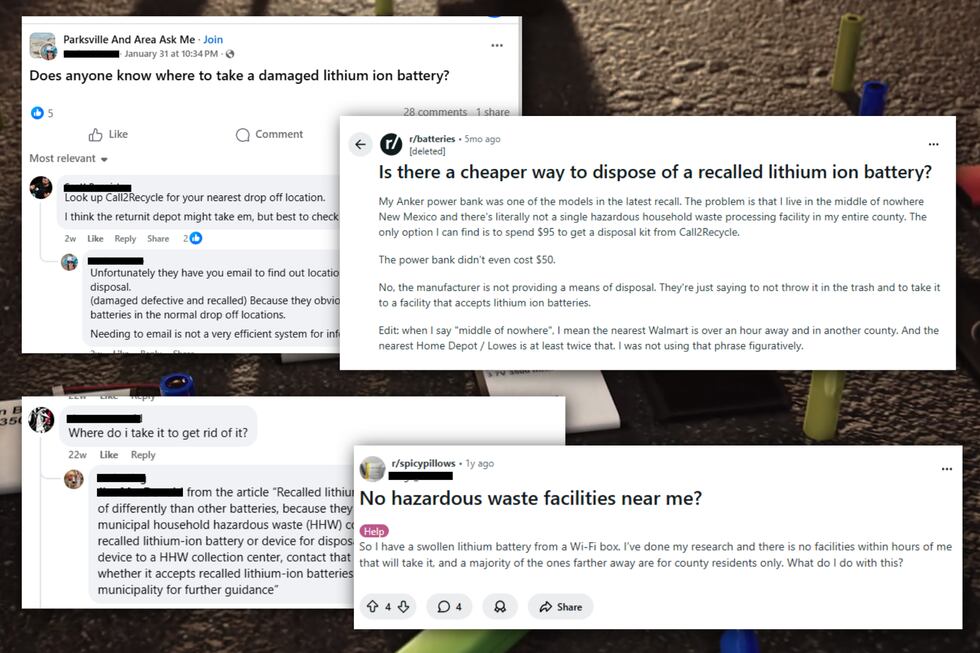
Numerous posts InvestigateTV found on social media sites show even when consumers recognize the risks, they are often unaware of the solutions available to them.
This becomes especially apparent when the batteries in question are damaged in some way.
For undamaged lithium-ion batteries, many communities and large retailers have drop-off options that, other than perhaps making an extra stop during their commute home, are relatively convenient for most consumers.
Groups such as The Battery Network and others have compiled online databases that allow users to find a drop-off location nearby.
However, while lithium-ion batteries require special handling generally, damaged, defective or recalled lithium-ion batteries are considered by federal regulators to be extremely hazardous waste.
In most cases, damaged lithium-ion batteries fall into the same category as explosives or ammunition when it comes to rules around storage and shipping.
InvestigateTV analysis of EPA Resource Conservation and Recovery Act data identified fewer than 500 facilities nationwide with permits or other regulatory indicators consistent with receiving and processing damaged lithium-ion batteries. Another roughly 200 facilities and seasonal events were found to have indicators consistent with acting as an intermediary between the public and a permitted destination by accepting and temporarily storing damaged batteries. However, InvestigateTV found evidence in the data that not even all of the identified facilities actually provide such services in practice.
The U.S. Department of Transportation has also issued permits to a handful of private companies that would allow them to either accept small numbers of damaged lithium-ion batteries and ship them to a permitted facility in approved fireproof containers, or to sell those shipping materials directly to consumers.
However, private companies that will accept damaged batteries often charge a fee to take them, and approved fireproof shipping materials often cost between $50-$100 per battery, which some say could create a financial disincentive.
“It’s one thing to take batteries somewhere. And have to pay? That might be a deterrent,” said Chris Griffin, supervisor of the Center for Hard to Recycle Materials in Athens, Georgia.
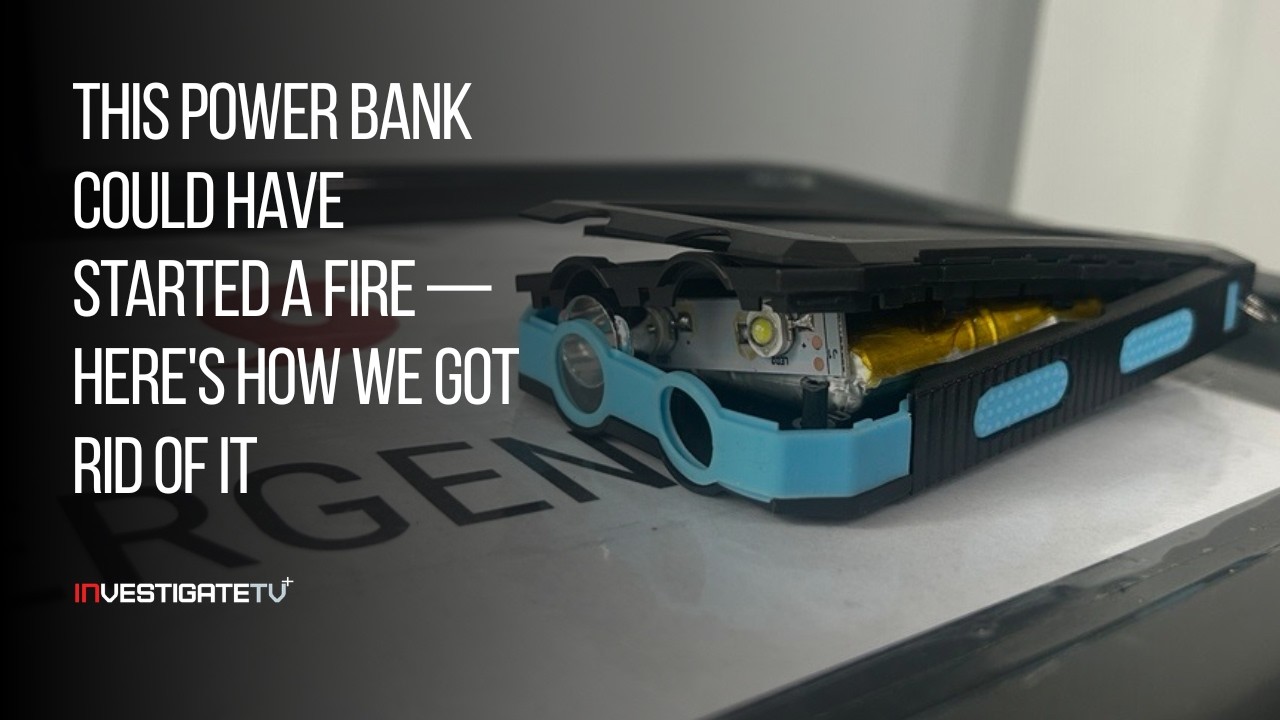
In February 2025, the local government facility began accepting all batteries completely free of charge — opting to accept the increased cost of handling them if it meant fewer potential fires.
“People are throwing away batteries, essentially, so to help try to mitigate some of that, we decided to take batteries for free,” Griffin said. “People don’t mind doing the right thing, if they can do it for free.”
‘We need to have a new system’
As facilities like CHaRM face the rising cost of just doing business, some, including the Product Stewardship Institute, argue dealing with hazardous, end-of-life lithium-ion batteries shouldn’t be their burden to bear.
“Producers have a responsibility, a major responsibility, for not only, you know, putting safe products on the market, but also to pay for and manage those products at the end of life,” Cassel said.
“Extended Producer Responsibility” (EPR) laws — regulations that generally require product manufacturers to provide avenues for consumers to recycle or safely dispose of materials when they are no longer usable — for batteries began popping up in a handful of states in the 1990s, largely to deal with growing concerns about automobile batteries.
Over the last five years or so, some of those states have updated their laws to include lithium-ion batteries, and a few more have passed such legislation.
InvestigateTV found that as of publication, 15 states have EPR laws in place requiring industry players to play a larger role, including some that require producers to directly foot at least some of the bill by offering consumers avenues to dispose of their batteries or by paying into funds set up to mitigate the costs for state and local programs.
“We’re asking them to take responsibility for the products that they put onto the marketplace,” Cassel said. “[From] upstream, as to how those products are made in the first place, and all the way post-consumer, after the consumer’s done with them, to manage those in a safe and responsible manner. To manage it, and to pay for it, and to be involved with others that are managing these [products].”
The industry has been involved in at least the legislative process when it comes to lithium-ion EPR laws.
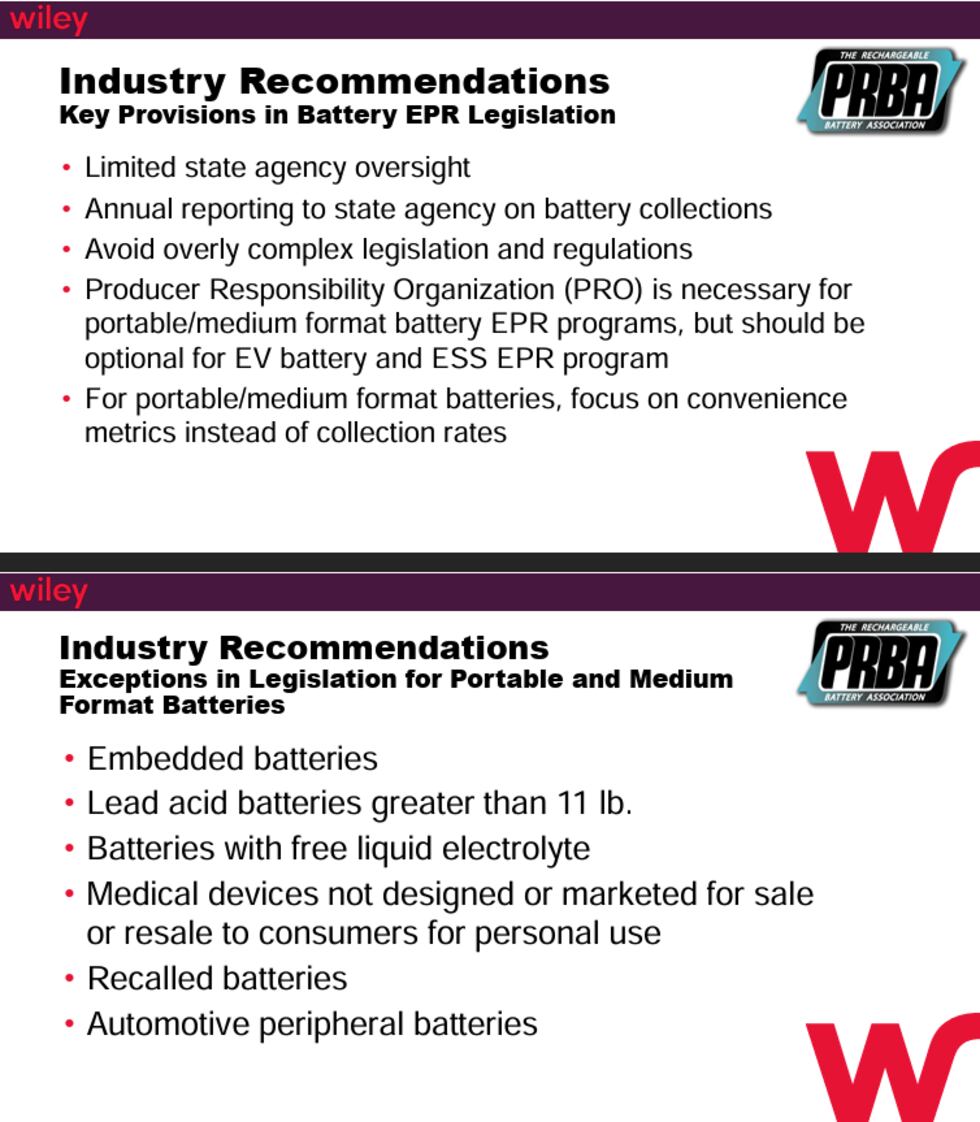
PRBA — The Rechargeable Battery Association — is an industry advocacy organization that is also responsible for the creation of The Battery Network. The group would not grant InvestigateTV an interview or provide comment, but the group’s website states it has “worked extensively” with state legislators on various state bills.
Representatives for the group have also participated in the EPA’s ongoing work to establish a federal framework for EPR programs, with the group’s talking points suggesting certain limitations and exemptions from state laws.
In the meantime, Cassel said it’s still early, but his organization has found states that have moved to pass EPR laws are already seeing benefits.
“Some of these laws have been in place only for maybe 5 years or so, and so the data are just coming out, but I can tell you that, yes, there’s significant increases of recycling with these systems in place, and the government taxpayer savings are very large,” he said.
Louisiana, where Rees lives, doesn’t have a battery EPR law, though the state has been promoting reclamation of lithium materials.
Rees, who had to have multiple surgeries to treat the burns he sustained in last summer’s fire, said the changes he’s gone through are more than skin-deep.
For one, he no longer uses lithium-ion powered charging banks.
“Some of it is just caution … understanding in a way that I didn’t understand viscerally how dangerous these things can be,” he said, adding: “I’m scared of these things, and I don’t want to have anything to do with them.”
As he spoke with InvestigateTV, Rees remembered that in recent months he had found two other devices with lithium-ion batteries that had begun to swell.
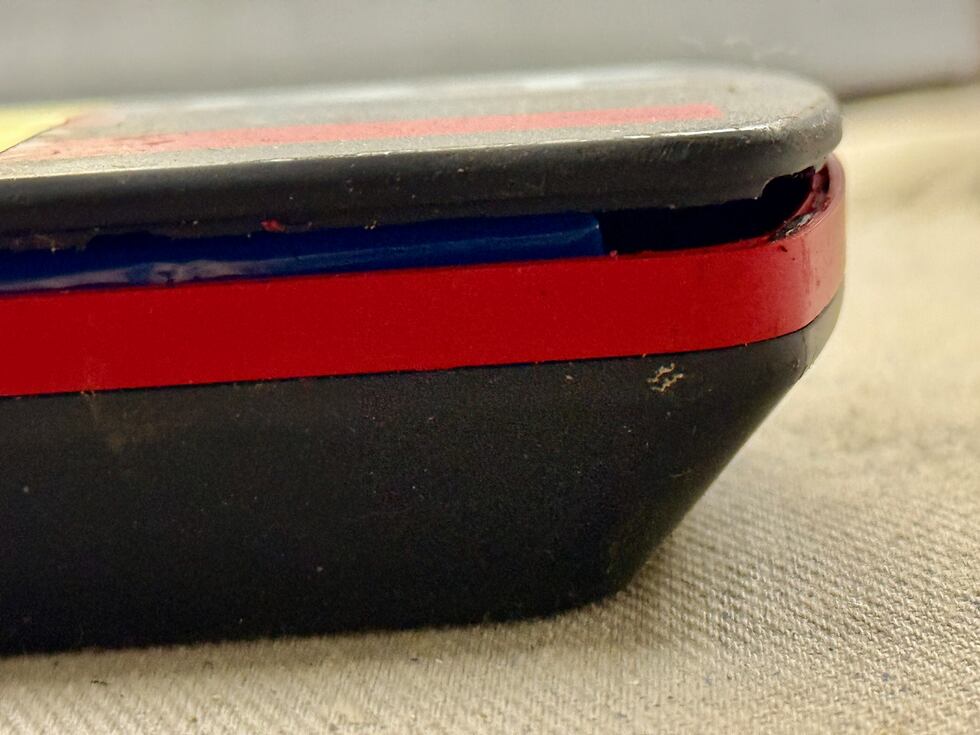
Knowing the risk, he relocated them to his carport and garage, but with no year-round public facility that will take them and previous experience at a retail drop-off location suggesting it would cost him $15-$20 to properly dispose of each one, he said he’s just holding onto them as long as the damage doesn’t seem to be getting worse.
“Something could happen,” he said. “Perhaps I’m being not cautious enough. Perhaps I’m just, putting them out of sight and that puts them out of mind.”
Jacob Spudich and Abigail Roedersheimer contributed to this report.
Copyright 2026 Gray Media Group, Inc. All Rights Reserved.